From 3 to 6 days to 10 days, the visa free transit policy has been further upgraded!
CCTV news: On December 17, the National Immigration Administration released a notice that from that day on, it will comprehensively relax and optimize the transit visa free policy, and extend the stay time of transit visa free foreigners in China from 72 hours and 144 hours to 240 hours (10 days). At the same time, 21 new ports will be added as entry and exit ports for transit visa free people, and further expand the stay area. What adjustments have been made to the announcement? What impact and changes will it bring
How to achieve "smooth travel" across regions
The biggest feature of this policy adjustment is allowing cross regional traffic. What issues need to be addressed and resolved after the adjustment, and how can various services achieve "smooth travel"
Dai Bin, President of China Tourism Research Institute: I think there are three issues that need further attention and resolution
Firstly, how to purchase international travel documents for transportation such as air, rail, subway, and public transportation. Nowadays, we often use online ticket booking. After booking the tickets, when entering the station, we swipe our ID card or even our face. However, when we use foreign travel passports, whether our machines are compatible is a big issue
Second, payment. When buying tickets online, foreigners have become accustomed to using electronic payment or some Internet payment methods. Although we have taken some measures, such as swiping cards in large amounts, scanning codes in small amounts, and providing cash, foreigners still face some payment problems
Third, language barriers or problems. Not every foreigner who enters the country can speak Chinese, and not every Chinese service staff can speak English or a specific language. Although some problems can be solved on the machine, I think there are still some communication barriers. How to break through the barriers of identification, payment, and language is the next key issue we need to focus on solving
How can resources be transformed into products to handle transit visa free traffic?
How should travel products be designed to accommodate transit foreign tourists in various regions?? How can second - and third tier cities that have not received foreign tourists prepare accordingly
Dai Bin: This is precisely the issue that our current cultural and tourism departments are focusing on, and we will pay attention to it from three aspects
Firstly, how resources can be transformed into products. We have many famous mountains and rivers, natural resources such as mountains, waters, forests, fields, lakes, grasses, and sands, as well as many historical and cultural resources. However, we still need to put in more effort to enable tourists to enter these spaces and turn them into tourist products that can be purchased
Secondly, how can culture be transformed into an experiential experience? We have a long history and culture, revolutionary culture that carries the red gene, and advanced socialist culture. How to enable foreign tourists to experience it is something we need to pay attention to
Thirdly, the government is very active in promoting it, but hotels, homestays, scenic spots, vacation areas, shopping places, etc. require further attention from us
How to make transit foreign tourists have fun eating and shopping
How can various regions enable transit foreign tourists to have "characteristic tours" and "in-depth tours" with richer experiences, and how can they make foreign tourists "not want to leave when they come" and "want to leave when they leave"
Dai Bin: Firstly, starting from demand, develop products that are more suitable for foreign tourists entering the country to consume. For example, do foreigners come to China only to see natural landscapes? Is it just a Citywalk for a city? Do they want to taste Chinese cuisine, buy some advanced and affordable products from China? How can we make foreign tourists aware of the information about these products? Our promotional methods and approaches need to be innovative
Secondly, the improvement of service quality. Nowadays, many of our ports, including shopping at airports, shopping malls, and duty-free shops, can still be quite awkward at times. In terms of shopping, business psychology, and service psychology, more international integration is needed to make people willing to buy, rather than rigidly promoting. After purchasing goods, there is also the convenience of logistics. After buying things from overseas companies, there is a specialized tax refund company service. Now Shenzhen has opened the first tax refund service point. There are also some bulk commodities or alcoholic beverages that cannot be carried because there is another journey, so the corresponding logistics system should also keep up at this time

From 3 to 6 days to 10 days, the visa free transit policy has been further upgraded!
-

What are astronauts doing these two days? New home in space
Today is the seventh day since the Chinese astronauts entered the China Space Station on the evening of June 17. It's just like they have just moved into a new house. In these days, the three astronauts have been busy moving things, unpacking, installing
Views: 15 Time 2021-06-24 -
Chang'e-5 will be on display in Hong Kong
According to Hong Kong media "Hong Kong 01" reported earlier, the Chinese lunar probe "chang'e-5" successfully brought 2 kg of lunar soil back to earth in December last year. Hong Kong people will have the opportunity to see "the
Views: 17 Time 2021-06-27 -
Hong Kong has banned local airliners from coming to Hong Kong since July 1 on Britain's implementation of the "circuit breaker mechanism" for regional flights
The government of the Hong Kong Special Administrative Region announced on June 28 that it would implement a "circuit breaker" mechanism for regional flights in the United Kingdom, banning all civil aircraft from landing in Hong Kong from 0:00 a
Views: 21 Time 2021-06-29 -
High speed railway conductor finds millions of gold
On July 16, Wang Bin, the conductor of Zhengzhou Bureau Group Company, made an inspection as usual. However, when he passed the 7 trains, he found that above the luggage rack of seat 14d, there was an insignificant small carton with multiple layers of tap
Views: 15 Time 2021-07-19 -

Malone responded to the fans' questions. He would talk to himself during the game and shout after winning the game
In fact, as an old fan for more than ten years, the editor wanted to know what the athletes shouted when he was a child? It seems that I understood Ma Lin at that time. Ma Lin often shouted "come on, hehe hehe". I always wondered what Wang Liqin
Views: 17 Time 2021-08-14 -

Sorry! Ma Jiaqi, who played "Jia Zheng" in the 1987 version of a dream of Red Mansions, died at the age of 82
On September 10, Ouyang Baoyu wrote on her microblog that she had just learned that Ma Jiaqi, the actor of "Jia Zheng" in a dream of Red Mansions, had died on September 2 at the age of 82. He also revealed that Ma Jiaqi is not only the actor of
Views: 27 Time 2021-09-10 -
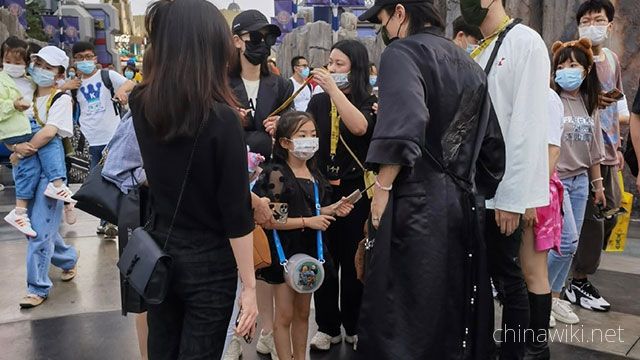
Netizens Universal Studios meet Nathan Lee's family
In September 15th, a group of friends took photos of a group of three people in Beijing Universal Studios and Qi Wei family. After all, the stars are really concentrating on daily attendance at the Universal Studios. The netizen in the photo said frankly
Views: 36 Time 2021-09-20 -

The first batch of satellites launched under China's State Grid program
According to a report on the website of the South China Morning Post in Hong Kong on December 16, China launched the first batch of satellites of a giant satellite Internet, joining the competition for space-based broadband Internet services at home and a
Views: 8 Time 2024-12-18 -

Ke Wenzhe resigned as chairman of Popular Party
However, the People's Party responded that they have no way of knowing the relevant details and called on the media and the outside world not to speculate recklessly.
Views: 16 Time 2024-12-19 -

Foreign media believes that competition with Chinese enterprises is one of the reasons for Honda and Nissan to negotiate a merger
Honda and Nissan announced that they will establish a new holding company to include both car companies in their business merger. Honda and Nissan have announced plans to achieve a business merger by August 2026
Views: 18 Time 2024-12-24 -
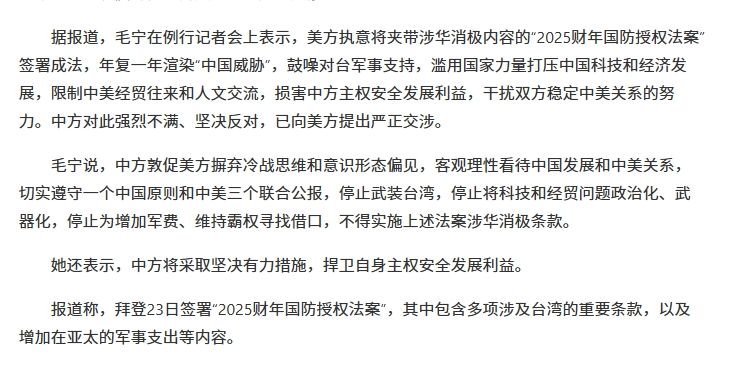
China urges US to stop arming Taiwan
According to a report on the website of Singapore's Lianhe Zaobao on December 24, in response to the signing into law of the "National Defense Authorization Act for Fiscal Year 2025" by US President Biden, which contains a number of Taiwan relat
Views: 18 Time 2024-12-25 -

Chinese drone expert Zhang Daibing passed away at the age of only 47
Zhang Daibing (1977-2025), male, born in Kaizhou District, Chongqing. He was the founder, chairman, and general manager of Changsha Yunzhihang Technology Co., Ltd. before his death
Views: 76 Time 2025-01-06