New year's Eve (Chu Xi)
New year's Eve is the last night at the end of the year. The last day at the end of the year is called "year division", which means that the old year will be removed and a new year will be replaced. To remove means to remove; Xi refers to night. "New Year's Eve" means new year's Eve, also known as new year's Eve, new year's Eve, new year's Eve, etc. it is the last night at the end of the year. New year's Eve is a day for new year's Eve, family reunion and ancestor worship. It is a traditional ancestor worship festival in Chinese folk, together with Qingming Festival, July half and Double Ninth Festival. New year's Eve is of special significance in the hearts of Chinese people. On this most important day at the end of the year, no matter how far away you are, you have to hurry home to reunite with your family, say goodbye to the old year in the sound of firecrackers, and fireworks are all over the sky to welcome the new year.
The last day of "Sui" is called "Sui Chu", and that night is called "New Year's Eve". It is connected with the new year from beginning to end, which is called "the end of the year and the end of the month, close to the end of the new year". It is the eve of the new year and an important time junction to get rid of the old and welcome the new year. New year's Eve is also called New Year's Eve because it usually falls on December 29 or 30 of the lunar calendar. On the day of the lunar new year, people pay special attention to it. Every household is busy or cleaning the courthouse, removing the old and putting on new clothes, putting on lanterns and decorations, welcoming the ancestors home for the new year, and offering sacrifices with New Year cakes, three animal meals and three teas and five wines.
On New Year's Eve, there have been rituals such as offering sacrifices to ancestors, keeping the year old, reunion dinner, pasting New Year's red and hanging lanterns since ancient times. Influenced by Chinese culture, new year's Eve is also a traditional festival for Chinese culture circle countries and overseas Chinese all over the world. In 2007, new year's Eve officially became a legal holiday in China in accordance with the measures for national holidays and anniversaries. In 2014, the new year's Eve was adjusted according to the decision of the State Council on Amending the measures for national holidays and anniversaries, and will no longer be regarded as a legal holiday in China.
New year's Eve Wiki:
| Chinese name | Chu Xi |
| Foreign name | ChineseNewYear'sEve |
| alias | New year's Eve, new year's Eve, new year's Eve, new year's Eve, new year's Eve |
| Holiday time | December 29 or 30 of the lunar calendar |
| Festival type | traditional festival |
| Epidemic area | China and other countries in the Chinese character cultural circle |
| Festival origin | Eliminate the old and bring forth the new, and offer sacrifices to ancestors |
| Festival activities | Clean the courthouse, paste New Year's red, worship ancestors and watch the new year |
| Holiday diet | family reunion dinner |
| Holiday significance | Get rid of the old and introduce the new, welcome the ancestors home for the new year |
| Origin time | Pre Qin Period |
| Holiday month | January or February of each year |
| interpretation | New year's Eve |
| The earliest New Year's Eve | January 20th |
| Latest new year's Eve | February 19th |
New year's Eve (Chu Xi) Festival origin
The end of the year is the day to get rid of the old and make new ones at the end of the year. New year's Eve is the night of new year's Eve, which is connected with the beginning of the year (New Year). The old year ends at this time, and a new year begins the next day. Therefore, it is commonly thought that new year's Eve. As a festival at the end of the new year, new year's Eve originated from the custom of offering sacrifices to ancestors at the end of the year in ancient times. The day of new year's Eve is a traditional ancestor worship Festival. Ancient books say: "heaven and earth are the foundation of life; ancestors are the foundation of class." It means that heaven and earth are the foundation of life, ancestors are the foundation of our mankind, and ancestor worship is a custom of inheriting filial piety.
The earliest reference to the name "New Year's Eve" in the existing literature is the local scenery chronicle written by Zhou Chu of the Western Jin Dynasty. The day before New Year's Eve is also called Xiaodi, that is, xiaonianye; New year's Eve is a big division, that is, new year's Eve. In addition, according to "Lu's spring and autumn · Ji Dong Ji", the ancients used drum beating to expel the "ghost of epidemic disease" on the day before the new year. At the end of each year, a "big Nuo" ceremony was held to expel the ghost of epidemic disease. It is said that this was also one of the customs of the "New Year's Eve" festival at that time.
New year's Eve is usually called New Year's Eve, but in fact, due to the lunar calendar, the date of new year's Eve may be December 30 or December 29, but in any case, it is the end of the lunar year.
New year's Eve (Chu Xi) social customs and habits
New year's Eve (Chu Xi) family reunion dinner
New year's Eve is extremely important for Chinese. On this day, people are ready to leave the old and welcome the new and have a reunion dinner. Family is the cornerstone of Chinese society. The annual reunion dinner fully shows the mutual respect and love of Chinese family members, which makes the relationship between families closer. Family reunion often gives the head of a family spiritual comfort and satisfaction. The elderly see their children and grandchildren everywhere, and the whole family talks about their relationship. The past care and efforts to raise their children have not been in vain. What a happiness. The younger generation can also take this opportunity to express their gratitude to their parents for their upbringing.
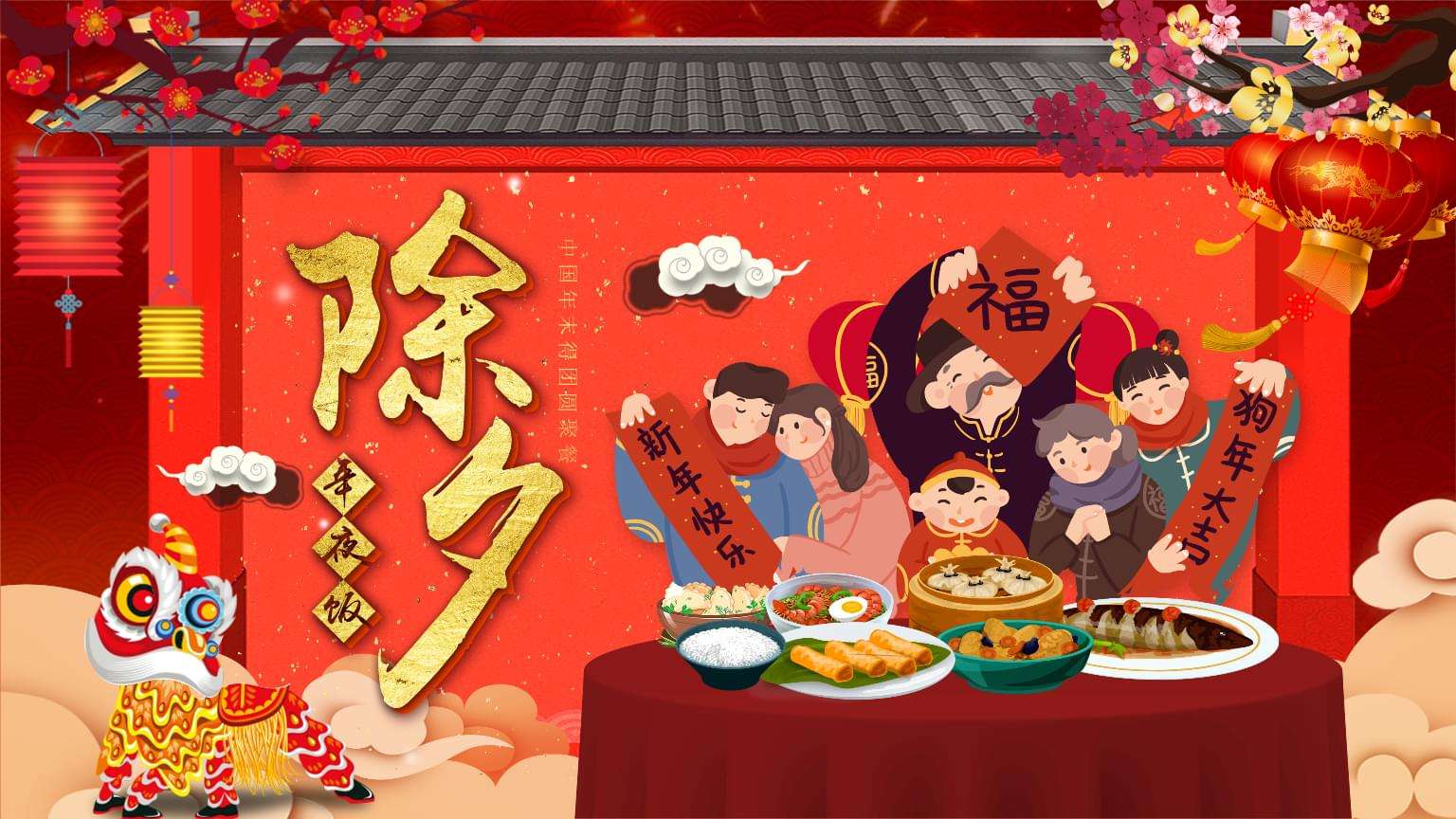
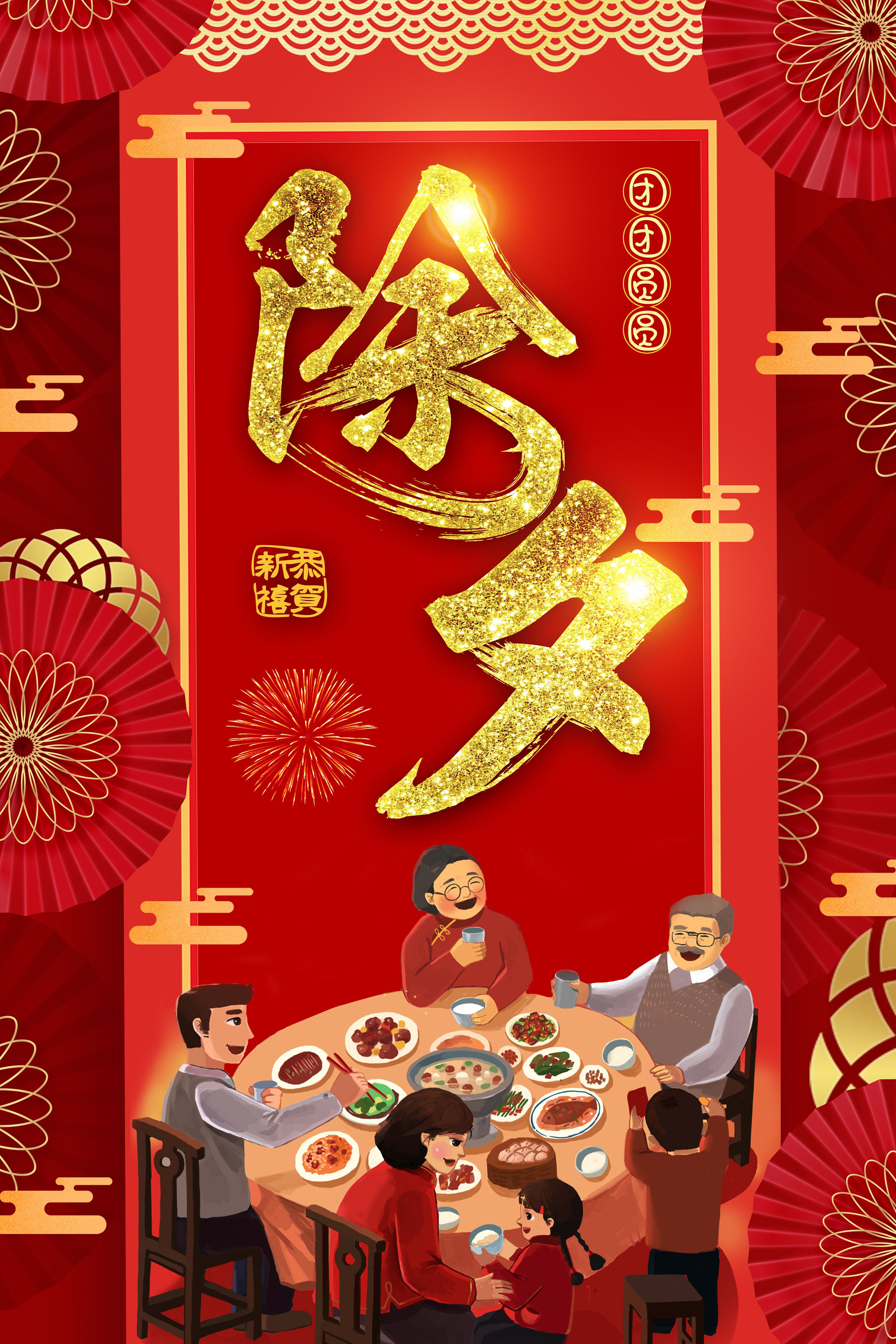
New year's Eve dinner is the most lively and happy time for every family on New Year's day. On the eve of the Lunar New Year's Eve, a table full of rich new year's dishes is arranged for family reunion. They sit around the table and eat the reunion dinner together. There are big dishes, cold pots, hot frying and snacks on the table. Generally, there are two things, one is hot pot and the other is fish. Hot pot boiling, steaming, warm and provocative, indicating red fire; "Fish" is homonymous with "surplus", which symbolizes "surplus in auspicious days" and "surplus every year". There is also radish, commonly known as vegetable head. I wish you a good color head; Fried food such as lobster and fried fish, I wish the family prosperity, such as "cooking oil with fire".
There are many famous things about the new year's Eve dinner, which are different from the north and the south, and each has its own stress. Northerners are used to eating dumplings during the Spring Festival, which is a habit handed down from ancient times. Due to geographical and climatic reasons, on New Year's Eve and the Spring Festival, the north is still in a cold winter when everything is closed. In winter, the northern region is white and icy. There is basically no way to plant crops. There are not many food materials to choose. Eat more dumplings for the new year. The southern region, especially some coastal areas, is basically green all the year round. In winter, the southern region has great advantages in vegetables, fruits and other food materials, so it has more selectivity in the choice of diet; In terms of geographical advantages, it also benefits from abundant water resources and wide distribution, so all kinds of fishing are sufficient and food materials are diverse; Therefore, on some important festivals, the diet in the South will be richer and more diverse.
New year's Eve (Chu Xi) Paste NianHong
Nian Hong is a general term for the red festive elements pasted on Spring Festival couplets, door gods, window flowers, New Year pictures, Fu characters and so on. It is a long-standing custom among Chinese people to stick New Year's red (waving spring) during the new year, which places people's longing for a happy life and wishes for a better future.
post new year's scrolls
Spring couplets are also called door pairs, spring stickers, couplets, couplets, Taofu, etc. they depict the background of the times and express good wishes with neat, dual, concise and exquisite words. They are a unique literary form in China. Every Spring Festival, every family, whether in urban or rural areas, should select a pair of Red Spring Festival couplets and paste them on their doors to increase the festive atmosphere for the festival. According to the records of works such as jade candle treasure book and Yanjing suishiji, the original form of Spring Festival couplets is what people call "Taofu". It is said that this custom began in the Song Dynasty and became popular in the Ming Dynasty. By the Qing Dynasty, the ideological and artistic nature of spring couplets had been greatly improved. The spring couplet monograph "Ganglian Conghua" compiled by Liang Zhangju discussed the origin of couplets and the characteristics of various works. There are many kinds of Spring Festival couplets. According to the place of use, they can be divided into door center, frame pair, horizontal poncho, spring strip, fighting square, etc. "Door center" is pasted on the center of the upper end of the door panel; "Frame pair" is pasted on the left and right door frames; "Horizontal drape" is pasted on the beam of the door; "Spring strips" are pasted in corresponding places according to different contents; "Dou Jin", also known as "door leaf", is a square diamond, which is mostly pasted in furniture and shadow wall.
Stick grilles
In China, people also like to stick all kinds of paper cuts - window flowers on windows. Window flowers not only set off the festive atmosphere, but also integrate decoration, appreciation and practicability. Paper cutting is a popular folk art in China. It has been loved by people for thousands of years. Because it is mostly pasted on windows, it is also called "window flower". With its unique generalization and exaggeration, the window flower expresses auspicious things and good wishes incisively and vividly, and decorates the festival with prosperity.
Paper cutting is a popular folk art in China, which has been deeply loved by people for thousands of years. Later, because most of the paper cutting is pasted on the window, the window flower is also named. The subject matter of window flower is extremely broad. Dramatic characters, historical legends, flowers, birds, fish and insects, landscape, real life and auspicious patterns can become the expression content of window flower, which can be described as omnipresent. But most of them are flowers and animals, festive and auspicious patterns, often with "auspicious and festive", "seeking good luck in a good year", "bumper harvests", "prosperity of six livestock", "surplus in successive years", "precious flowers and auspicious birds" as the main body.
Paste Fu character
While pasting the Spring Festival couplets, some people want to paste the words "Fu" large and small on the door, wall and lintel. It is a long-standing custom for Chinese people to paste the word "Fu" during the Spring Festival. The word "Fu" refers to good fortune and good luck, which reposes people's longing for a happy life and wishes for a better future. In order to fully reflect this yearning and wish, some people simply put the word "Fu" upside down, indicating that "happiness has come" and "blessing has fallen (to)". In fact, the word "Fu" can't be pasted upside down. The gate is the place to welcome the blessing, and the word "Fu" should be pasted right. The places where Fu characters are pasted upside down are generally water tanks, dustbins, and cabinets at home. Chinese folk also make various patterns of the word "Fu", such as longevity star, longevity peach, carp jumping over the dragon's gate, bumper grain harvest, dragon and Phoenix.
Hanging New Year pictures
Hanging New Year pictures during the Spring Festival is also very common in urban and rural areas. The dark and colorful new year pictures have added a lot of prosperity and joy to thousands of households. New Year pictures are an ancient folk art in China. They reflect the simple customs and beliefs of the people and place their hopes for the future. New Year pictures, like Spring Festival couplets, originated from the "door god". With the rise of wood printing, the content of New Year pictures is not limited to monotonous themes such as door gods, but has become rich and colorful.
New year's Eve (Chu Xi) Firecrackers
There is a saying among Chinese people that "open the door to firecrackers". That is, on the arrival of the new year, the first thing for every family to open the door is to set off firecrackers to get rid of the old and welcome the new with the sound of beeping firecrackers. Firecrackers are Chinese specialties, also known as "explosive battle" and "artillery battle". In the Tang Dynasty, "explosive pole" was written. All parts of the south are also known as "paper gun" and "cannon". If many individual firecrackers are connected into a string, they are called "firecrackers", "sound whip" and "whip". Setting off firecrackers can create a festive and lively atmosphere. It is an entertainment activity of the festival and can bring happiness and auspiciousness to people.
As for the evolution process of firecrackers, popular choreography excellent records: "in ancient times, firecrackers were all made of real bamboo, so they were also called exploding poles in Tang poetry. Later generations rolled paper and called them" firecrackers ". With the passage of time, firecrackers are more and more widely used, and there are more and more varieties and colors. Setting off firecrackers has become an entertainment activity with national characteristics. People set off firecrackers to celebrate the Spring Festival.
New year's Eve (Chu Xi) Ancestor worship
In ancient times, such rites and customs were very popular. "Heaven and earth are the foundation of life; ancestors are the foundation of class." It means that heaven and earth are the foundation of life, ancestors are the foundation of our mankind, and ancestor worship is a custom of inheriting filial piety. Due to different rites and customs, the forms of ancestor worship are also different. Some go to the field to pay homage to their ancestors' tombs, some go to ancestral temples to pay homage to their ancestors, and most of them place their ancestral tablets in the main hall in turn at home to display offerings, and then the worshippers worship and kneel down in the order of age. The ancients worshipped their ancestors, mostly making fish bowl dishes, filled with high bowls, which is quite the meaning of Zhong Ming Ding Shi. Southerners are especially ceremonious in offering sacrifices to their ancestors. Most of them are eight bowls of big dishes, medium hotpot, and cup sheaths set according to the spirit position.
New year's Eve (Chu Xi) Shou Sui
Keeping the new year's Eve is one of the new year's customs activities, which has a long history. The folk custom of keeping the year-old is mainly manifested in that all houses light the year-old fire, the family get together happily, keep the "year-old fire" and wait for the time to leave the old and welcome the new year. On New Year's Eve, the lights are kept on all night, which is called "lighting a lamp to illuminate the new year" or "lighting a new year's fire". All houses are lit with lights and candles, and lights and candles are specially lit under the bed. It is called "lighting wasted". It is said that after such lighting, the wealth of the family will be enriched in the coming year. In ancient times, there were different customs between the north and the south. In ancient times, the custom of keeping watch for the new year in the North was mainly "staying up all night" (keeping watch all night). For example, in the record of Customs written by Zhou Chu of the Jin Dynasty, it said that everyone gave gifts on New Year's Eve, which was called "giving the new year"; Children and elders get together to celebrate the perfect celebration, which is called "age division"; Staying awake until dawn is called "Shou Sui". In some places, on New Year's Eve, the whole family get together, have a new year's Eve dinner, light candles or oil lamps, sit around the stove, chat and watch all night, which symbolizes driving away all evil plagues and looking forward to the good luck of the new year.
New year's Eve (Chu Xi) Hanging lanterns
Hanging lanterns during the Chinese New Year is an ancient custom in China. Red represents festivity, while round lanterns symbolize reunion and happiness. Red lanterns symbolize peace, harmony and prosperity. Chinese lanterns are also called lanterns. It is said that it originated in the Western Han Dynasty more than 1800 years ago. Before and after the new year's Eve every year, people hang red lanterns symbolizing the meaning of reunion to create a festive atmosphere. On New Year's Eve, when people are watching the new year's Eve, red lanterns are hung at the door, a red fire is burning in the main room, candles or oil lamps are lit, and the whole family is talking around the table.
New year's Eve (Chu Xi) Lucky money
Lucky money is one of the customs of the Chinese New Year. After the new year's dinner, the elders should distribute the lucky money prepared in advance to the younger generation. It is said that the lucky money can suppress evil deeds, and the younger generation can spend a year in peace when they get the lucky money. Lucky money means to ward off evil spirits and exorcise ghosts and bless peace in folk culture. The original intention of lucky money was to ward off evil spirits. Because people think that children are vulnerable to sneakiness, they use lucky money to dispel evil spirits. In history, the new year's money is divided into many kinds. Generally, it is distributed to the younger generation by the elder during the countdown to the new year, which indicates the pressure, including the elder's concern and sincere wishes for the younger generation; The other is given to the elderly by the younger generation. The "year" of the lucky money refers to years, which is intended to look forward to the longevity of the elderly. The earliest lucky money that can be traced back was in the Han Dynasty, also known as Yasheng money. It was not circulated in the market, but a toy in the form of coins, which had the function of avoiding evil spirits.
Giving new year's money for the new year reflects the care of the elders for the younger generation and the respect of the younger generation for the elders. It is a folk activity integrating family ethical relations.
New year's Eve (Chu Xi) Festival taboo
When new year's Eve comes, people celebrate the festival and harvest, bathe, change clothes and clean up to drive away epidemics and evil spirits. Folk taboos on New Year's Eve:
1. The word of blessing cannot be pasted upside down. The gate is the place to welcome the blessing, and the word of blessing should be pasted directly. The places where Fu characters are pasted upside down are generally water tanks and dustbins.
2. If your door is aimed at the door of your neighbor's house, be sure to hang two Chinese knots on the door frame outside your door to seek advantages and avoid disadvantages.
3. Avoid taking out sewage, garbage, sundries, sweeping, watering and defecating everywhere. It is said that such carelessness will splash on the gods. If the gods are angry, it will bring disaster to people.
4. No matter whether you are keeping watch or not, don't turn off the lights in the house. You should keep them on all night, which means that the future of the coming year is bright.
5. Remember to pay off the debt before the new year. If you have owed the new year, you can't come to collect the debt from the first to the fifth day of the new year.
6. Avoid saying unlucky words.
7. During the Chinese new year, fish is a necessary dish, which is called "surplus". When eating fish, you should leave your head and tail behind, which means that there is not only food and clothing, but also surplus in the coming year.
New year's Eve (Chu Xi) Allusions and legends
New year's Eve (Chu Xi) Legend of Xi
In fairy tales and legends, there was an evil beast with four corners and four feet in ancient times - Xi. It was short of food due to the heavy snow in winter. It often went to the nearby villages to find food. Because of its huge body, grumpy temper and ferocity, it brought great disasters to the villagers. At the end of the lunar month, people tidy up their clothes, help the old and children, and take refuge in the nearby bamboo forest. Later, a clever child taught us the method of new year's Eve. His name was "Nian". Because "Xi" is not dead, every year on the 30th of the twelfth lunar month, everyone watches the broken bamboo Festival and waits, hoping to get rid of "Xi" as soon as possible. However, year after year, no one has seen "Xi" again. There are only firecrackers set off by everyone to prevent the arrival of "Xi" and red cloth strips hung in front of the door. However, this legend and new year's custom are left to us: on the night of the third lunar month, everyone gets together to eat new year's Eve dinner and wait for the bell on New Year's Eve. Set off firecrackers and stick door couplets. Wait until dawn to visit each other's neighbors and give greetings and blessings. On the morning of the first day of the new year, the villagers visited each other to see if their neighbors were injured and said some auspicious and polite words. I hope the "Xi" of the twelfth lunar month in the coming year will not come again.
New year's Eve (Chu Xi) Qilang shooting Xi
It is said that long ago, there was a monster called "Xi". This guy specializes in harming people, especially if he sees a beautiful girl in any family, he will spoil her at night. Then I have to eat the girl. People hate it to death, but there is no way. There was a hunter named Qilang who wanted to get rid of the common people when he saw that they had been hurt by Xi. He took the dog everywhere to look for "Xi", and he couldn't find it. It turned out that "Xi" didn't come out during the day. It didn't come out until the sun set to harm people. It disappeared after midnight. No one knew where it lived. Qilang had been looking for "Xi" for a year. It was the 30th day of the twelfth lunar month. That night, "Xi" really came. Qilang sent out hunting dogs to bite him, and "Xi" fought with Qilang and the dog. As soon as people heard that they were killed outside, they picked up things and knocked loudly. At this time, "Xi" was a little fighting, but he wanted to escape. He didn't know that his hind leg was bitten by a hound. Qilang took the opportunity to shoot with his bow and killed Xi with one arrow. Since then, people have called the 30th day of the twelfth lunar month "New Year's Eve". That night, every family should keep watch and fire artillery to drive away the bad luck and welcome happiness and auspiciousness.
New year's Eve (Chu Xi) Stay up for years
ShouSui is the custom of staying up late to welcome the arrival of the new year on the last night of the old year. It is also called ShouSui on New Year's Eve, commonly known as "boil the new year". Exploring the origin of this custom, there is an interesting story among the people:
In ancient times, there was a kind of fierce monsters scattered in the mountains and forests. People called them "Nian". Its appearance is ferocious, fierce and cruel, and it is devoted to birds and animals, scales and insects. One day, it changes to a taste, and from the * to the big living people, it lets people talk about the "year". Later, people gradually mastered the activity law of "Nian". It was to try fresh food every 365 days in the place where the crowd lived. Moreover, it haunted after dark. When the chickens crowed at dawn, they returned to the mountains and forests.
After calculating the date of the "Nian" rampage, the people regarded this terrible night as a gateway, called the "Nian Guan", and came up with a set of ways to pass the new year's Eve: every family prepared dinner in advance, turned off the fire and cleaned the stove, tied all the chicken pens and cattle pens, sealed the front and rear doors of the house, and hid in the house for the "New Year's Eve dinner", Because this dinner has the meaning of bad luck and uncertainty, it is very rich. In addition to asking the whole family to have a meal together to express harmony and reunion, it is also necessary to offer sacrifices to the ancestors before eating, pray for the blessing of the gods of the ancestors, and spend the night safely. After dinner, no one dares to sleep and sit together to chat and strengthen their courage. It gradually formed the habit of staying up for the new year's Eve.
The custom of keeping the year old rose in the northern and Southern Dynasties. Many scholars in the Liang Dynasty had poems and articles about keeping the year old. "One night for two years, five watch for two years." People light candles or oil lamps and keep vigils all night, symbolizing that all evil plagues are driven away and looking forward to the good luck of the new year. This custom is spread by people.
New year's Eve (Chu Xi) Spring festival couplet door god
New year's Eve (Chu Xi) Spring Festival couplets
It is said that the custom of pasting Spring Festival couplets began in the post Shu period more than 1000 years ago, as evidenced by history. In addition, according to the records of works such as jade candle treasure book and Yanjing suishiji, the original form of Spring Festival couplets is what people call "Taofu".
In ancient Chinese mythology, it is said that there is a world of ghosts, in which there is a mountain. On the mountain, there is a big peach tree covering three thousand miles, and there is a golden chicken on the top of the tree. Whenever the golden rooster crows in the morning, the ghosts wandering at night will rush back to the haunted area. The gate of the ghost kingdom is located in the northeast of the peach tree. Beside the gate are two gods named shenta and Yulei. If the ghost does something harmful at night, Shentu and Yulei will immediately find it and catch it, tie it up with a rope made of mang reed and send it to feed the tiger. Therefore, ghosts all over the world are afraid of Shentan and Yulei. So the people carved their appearance with peach wood and put it at their own door to avoid evil and harm. Later, people simply engraved the names of divine tea and Yu Lei on the mahogany board, believing that doing so can also suppress evil and eliminate evil. This kind of peach board was later called "peach talisman".
In the Song Dynasty, people began to write couplets on mahogany boards. First, they did not lose the significance of mahogany to suppress evil, second, they expressed their good wishes, and third, they decorated the door for beauty. Couplets are also written on red paper symbolizing happiness and auspiciousness and pasted on both sides of doors and windows on the occasion of the Spring Festival to express people's good wishes for good luck in the coming year.
New year's Eve (Chu Xi) door-god
In order to pray for the well-being of the family, people in some places still keep the habit of sticking door gods. It is said that when two door gods are pasted on the gate, all demons and ghosts will be afraid. Among the people, the door god is a symbol of righteousness and force. The ancients believed that people with strange looks often have magical temperament and extraordinary skills. They are honest and kind-hearted. It is their nature and responsibility to catch ghosts and demons. Zhong Kui, the ghost catching Heavenly Master admired by people, is such a strange appearance. Therefore, the folk door gods are always angry and ferocious, holding all kinds of traditional weapons, ready to fight the ghosts who dare to come to the door at any time. Because the doors of Chinese folk houses are usually two opposite doors, the door gods are always in pairs.
After the Tang Dynasty, in addition to the previous two generals of Shentu and Yulei, Qin Shubao and Yuchi Gong were regarded as door gods. It is said that Emperor Taizong of Tang Dynasty was ill and heard the call of ghosts outside the door. He was restless all night. So he let the two generals stand by the door with weapons, and there was no ghost harassment the next night. Later, Emperor Taizong of the Tang Dynasty asked people to draw the images of the two generals and paste them on the door. This custom began to spread widely among the people.
New year's Eve (Chu Xi) Literary account
first day of first lunar month
——Wang Anshi
In the sound of firecrackers,
The spring breeze brings warmth to Tu su.
The days of thousands of families,
Always exchange new peaches for old ones.
Shou Sui
——Su Shi
If you want to know how old you are, you are like a snake in a gully.
The scales are half gone. Who can cover the meaning.
Kuang wants to tie his tail, although he knows how to do it frequently.
Children are forced to stay awake and enjoy each other at night.
If the morning chicken does not sing, it is more afraid to add Lao.
After sitting for a long time, the embers of the lamp fall, and I get up to see the Beidou slope.
There will be no year next year. I'm afraid my mind will be wasted.
Try your best tonight, young people can still boast.
Except night work
——Gao Shi
The cold light in the hotel doesn't sleep alone. What's the matter with the guest heart?
Hometown tonight thinking thousands of miles, frost temples, another year of the Ming Dynasty.
In addition to the night
——Wen Tianxiang
Heaven and earth fall in the air, and time goes by;
The end of the road is full of wind and rain, and the poor side is full of snow and frost.
Life goes with the years, and the body is forgotten with the world;
Wu Fu slaughters Su Meng and lights up the night.
New year's Eve
-
1.Spring Festival (Chun Jie)
Spring Festival, the Chinese Lunar New Year, is commonly known as the new year, the new year, the new year's day, etc. it is also known orally as the new year and the new year. The Spring Festival has a long history, which evolved from the worship of pray
Time 2020-12-26 -
2.Mid-Autumn Festival (ZhongQiu Jie)
Mid Autumn Festival, also known as Moon Festival, moon birthday, moon Eve, autumn festival, Mid Autumn Festival, moon worship Festival, moon mother's day, Moon Festival and reunion festival, is a traditional festival among Chinese people. The Mid Autumn F
Time 2020-12-26 -
3.Lantern Festival (Yuan Xiao Jie)
The Lantern Festival, one of the traditional festivals in China, is also known as the Shangyuan Festival, the small first month, the new year's Eve or the Lantern Festival. The time is the 15th day of the first month of the lunar calendar every year.The f
Time 2021-01-02 -
4.Dragon Head Raising Day (Long Tai Tou)
Dragon head up (February 2 of the lunar calendar), also known as spring ploughing Festival, agricultural Festival, Qinglong Festival and spring Dragon Festival, is a traditional Chinese folk festival. "Dragon" refers to the seven constellations
Time 2021-01-02 -
5.Community day (SheRi Jie)
Social day, a traditional Chinese festival, also known as land birthday, is an ancient Chinese traditional festival. Social day is divided into spring society and autumn society. In ancient times, the date of social day festival was determined according t
Time 2021-01-02 -
6.Shangsi Festival (Shangsi Jie)
Shangsi Festival, commonly known as March 3, is a traditional festival of the Han nationality. It was set as the fourth day in early March before the Han Dynasty, and later fixed on the third day of March in the summer calendar. Shangsi Festival is the m
Time 2021-01-02 -
7.Cold food festival (HanShi Jie)
Cold food festival, a traditional Chinese festival, falls on the 105th day after the summer solstice and the first or second day before Qingming Festival. It is the first day of the festival. Fireworks are forbidden and only cold food is eaten. In the dev
Time 2021-01-02 -
8.The Dragon Boat Festival (DuanWu Jie)
The Dragon Boat Festival, also known as the Dragon Boat Festival, the Dragon Boat Festival, the Double Ninth Festival and the mid day festival, is a folk festival integrating worship of gods and ancestors, praying for blessings and ward off evil spirits,
Time 2021-01-02 -
9.Double Ninth Festival (Chong Yang Jie)
The Double Ninth Festival, a traditional Chinese Folk Festival, falls on the ninth day of the ninth lunar month. The number of "Nine" is the number of Yang in the book of changes. The number of "Nine" and the number of Yang are equal,
Time 2021-01-02 -
10.Xia Yuan Festival (Xia Yuan Jie)
Xiayuan Festival, a traditional Chinese festival, is also called "Xiayuan day" and "Xiayuan day" on October 15 of the lunar calendar. It is one of the traditional Chinese folk festivals.On the fifteenth day of the first month, China ca
Time 2021-01-02 -
11.Winter solstice (Dong Zhi)
The winter solstice, also known as the South solstice, winter festival and Asian year old, has both natural and humanistic connotations. It is not only an important solar term in the 24 solar terms, but also a traditional ancestor worship festival among C
Time 2021-01-02 -
12.New year's Eve (Chu Xi)
New year's Eve is the last night at the end of the year. The last day at the end of the year is called "year division", which means that the old year will be removed and a new year will be replaced. To remove means to remove; Xi refers to night.
Time 2021-01-02