"Zhurong" takes you to see "Huoyan", "huochen", "huosha"
Beijing, July 9 (Zhao Zhuqing) - as of July 8, the Mars Rover "zhurong" has been working on the surface of Mars for 54 Mars days with a mileage of more than 300 meters, according to the official wechat message of China's lunar exploration project. Since the Mars rover arrived on the surface of Mars, it has been traveling southward to carry out patrol exploration. The navigation Terrain Camera images the landforms along the way every day. During the journey, the subsurface radar, weather measuring instrument and Mars magnetometer are turned on for exploration. When encountering rocks, sand dunes and other special landforms on the way, the surface composition detector and multispectral camera are used to carry out fixed-point exploration.
The images of Martian rocks taken on the road are composed of multi spectral data obtained by multispectral camera. In the images, we can see the texture features of Martian rocks, the ruts of Mars rover, and the coverage of Martian dust on the rock surface.
In the image of Mars rocks, we can see the texture features of Mars rocks and the ruts of Mars rover. Picture provided by National Space Administration
Martian rocks and dust show the coverage of Martian dust on the surface of rocks. Picture provided by National Space Administration
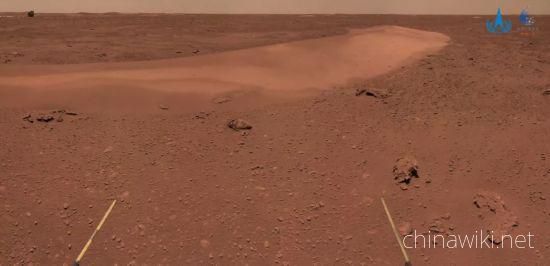
On June 26 (the 42nd Mars day), the rover arrived at a sand dune area and took a high-resolution image of the red sand dune using the navigation Terrain Camera (Fig. 3). The shooting point was about 6 meters away from the sand dune, surrounded by stones of different sizes, of which the stone facing the rover was about 0.34 meters wide.
On July 4 (the 50th Mars day), the rover drove to the south side of the sand dunes and sensed and imaged the surrounding landform. The whole picture of the sand dunes can be seen in Figure 4, which is about 40 meters long, 8 meters wide and 0.6 meters high. In Figure 5, a cluster of stones with different shapes is shown on the left, and the back cover and parachute can be seen in the upper right corner. During the imaging, the linear distance between the rover and the landing point is about 210 meters, and the distance between the rover and the back cover and parachute is about 130 meters.




"Zhurong" takes you to see "Huoyan", "huochen", "huosha"
-
1.Yuan Longping's son takes over the baton and continues the "Yuan dream plan"
Yuan Longping, winner of the "Medal of the Republic", academician of the Chinese Academy of engineering, director of the National Hybrid Rice Engineering Technology Research Center, and former vice chairman of the Hunan Provincial Committee of t
Time 2021-06-21 -
2.The 65 year old plays with his mobile phone 11 hours a day. How about you?
The 65 year old plays with his mobile phone for 11 hours a day. How about you According to @ Guangzhou Daily, since two months ago, Aunt Liu, 65, of Ningbo, Zhejiang Province, often felt dizzy and nauseous. She went to neurology department, spinal surgery
Time 2021-06-24 -
3.The representative of China refutes Japan's defense on the issue of nuclear polluted water discharged into the sea
Geneva, June 23 (Xinhua) at the 47th session of the UN Human Rights Council on June 23, the Chinese Delegation further refuted the Japanese representative's argument that "Japan has always handled the purified" treated water "of the Fukushi
Time 2021-06-25 -
4.Why do elephants run around? The answer lies in their special body structure
In recent days, the elephants are foraging in fuliangpeng Township, Eshan County, with an altitude of 2074 meters. Over 2000 meters, generally speaking, elephants usually move in areas less than 1000 meters. High altitude means that the diet of elephants
Time 2021-06-27 -
5."Jiang Ziya" was awarded the July 1st medal by lantianye at the ceremony of awarding the July 1st medal
At the July 1 medal awarding ceremony, lantianye, the actor of Jiang Ziya, was awarded the July 1 medal. At the age of 94, he is still active on the stage of the drama. LAN Tianye, the veteran dramatist, was once an underground party in Peking
Time 2021-06-29 -
6.The 60 year old man in Hainan was rescued after drifting in the sea for more than 20 hours. The search and rescue personnel were shocked when they knew the length of drifting
On July 11, a 160 year old man in Wenchang, Hainan, was rescued by a ship after drifting on the sea for more than 20 hours.
Time 2021-07-12 -
7.BMW China acquired brilliance "China" brand with an investment of 1.633 billion yuan
After more than nine months of bankruptcy and reorganization, brilliance group finally made the latest progress. On the morning of August 31, the substantive merger and reorganization of 12 enterprises such as brilliance group held the second creditors' m
Time 2021-09-01 -
8.At the age of 41, she established China's first private university for 30 yuan
She was burned all over her body and bedridden for three years, but refused to be a 'useless person'; She started with 30 yuan and established China's first private undergraduate university, which was called a "miracle in the history of world educati
Time 2024-12-06 -
9.The central government sets the tone and proposes a moderately loose monetary policy
The Political Bureau of the Central Committee of the Communist Party of China held a meeting on December 9th to analyze and study the economic work in 2025. The meeting pointed out that next year we must adhere to the principle of seeking progress while m
Time 2024-12-09 -
10.Xi Jinping Meets with Leaders of Major International Economic Organizations
On the morning of December 10, 2024, President Xi Jinping met with the heads of major international economic organizations who came to China to attend the "1+10" dialogue at the Great Hall of the People in Beijing.
Time 2024-12-10 -
11.2023 'China Intangible Cultural Heritage Person of the Year' announced
The results of the selection of the "Chinese Intangible Cultural Heritage Person of the Year" in 2023 were announced in Beijing on November 15th. The 10 "Chinese Intangible Cultural Heritage Annual Figures of 2023" are: Zhao Lingyun, a
Time 2024-12-10 -
12.The new nuclear power unit of "Hualong One" has been put into commercial operation
According to a report by the German newspaper "S ü ddeutsche Zeitung" on January 2nd, China's nuclear energy is flourishing at an unprecedented speed today
Time 2025-01-04